Is artificial intelligence changing the world, or are we watching history repeat itself?
There's an old saying that history doesn't repeat itself, but it often rhymes. And right now, the AI investment frenzy is starting to sound remarkably familiar.
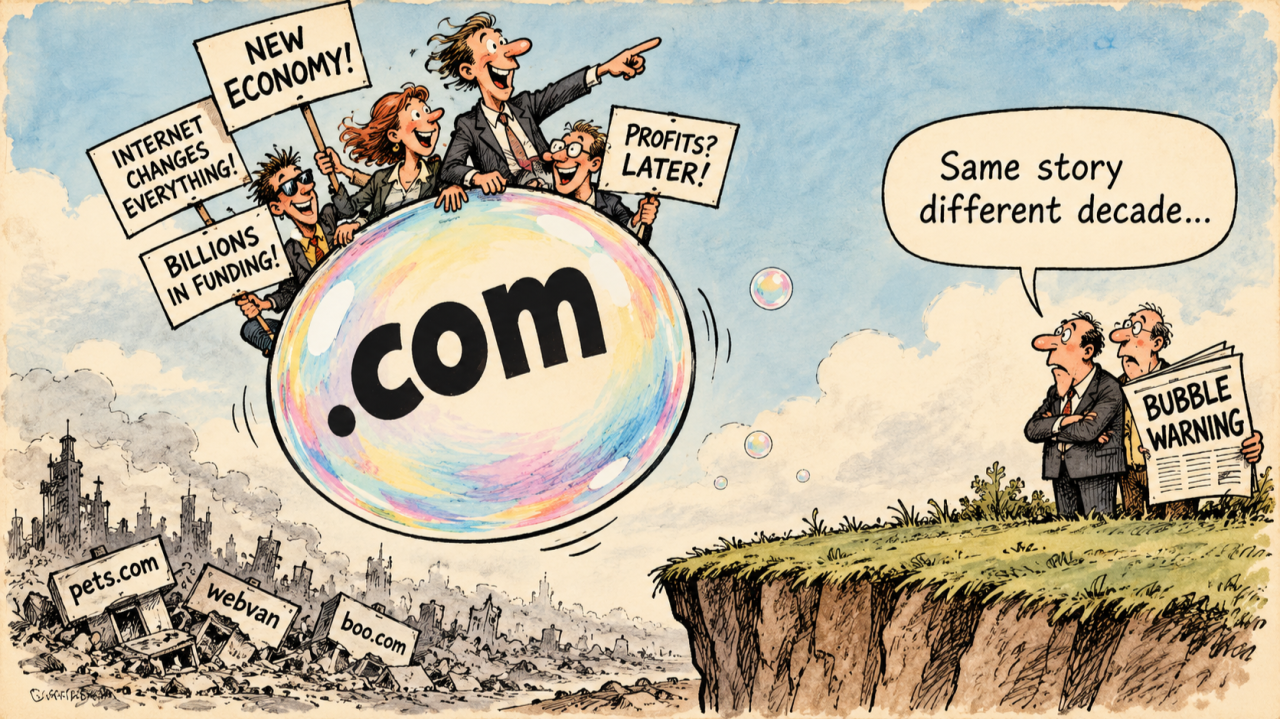
Cast your mind back to the late 1990s. The internet was going to change everything. Investors threw billions at anything with a ".com" attached to its name. Business models? Profitability? Cash flow? Minor inconveniences. The important thing was getting aboard before the train left the station.
Then came 2000. The technology survived. Many of the businesses didn't. And an extraordinary amount of shareholder value disappeared.
Fast-forward a quarter of a century, and here we are again. Different technology, different players, considerably bigger numbers, but some remarkably familiar behaviour.
Let me be clear. I am not suggesting AI is a fad. Far from it.
Artificial intelligence is already transforming how organisations operate, analyse information, serve customers, and make decisions. Its potential is enormous, and we are probably only scratching the surface.
But there's a fundamental difference between a technology being revolutionary and every investment associated with it being commercially sound.
And that, I believe, is where the conversation needs a little positive agitation.
The numbers are becoming rather uncomfortable.
We're witnessing extraordinary chunks of change being chucked at AI infrastructure, data centres, computing capacity, and energy requirements. The technology giants are spending at a scale that would have been almost unimaginable a decade ago.
Much of that investment may ultimately prove justified. But the question is not simply how much money is being invested. It's how much sustainable economic value that investment will generate, for whom, and when.
Recent market behaviour suggests investors are beginning to ask some awkward questions.
On 14 October, AI infrastructure-related shares came under considerable pressure, with Nebius falling approximately 15.1%, CoreWeave 9.5% and Oracle 7.2%, according to Reuters.
Then, on 19 October, S&P Global warned that major technology companies could have more AI-related financial obligations than currently visible, partly because of complex and interconnected financing arrangements.
S&P also estimated that six major US hyperscalers could collectively spend more than $7 trillion on data centres and other AI-related capital expenditure between 2025 and 2030.
Now, one market sell-off does not constitute a bubble bursting. Nor does substantial investment automatically mean financial recklessness.
But when a leading credit ratings agency begins raising questions about financing visibility and whether anticipated profits will materialise, perhaps it's time to pay attention.
The issue is not whether AI works. Increasingly, it does.
The issue is whether the economics supporting some of these extraordinary valuations actually work.
We've seen this movie before
During the dot-com boom, companies were valued on website traffic, user acquisition and promises of future market dominance.
Today, we're hearing about computing capacity, model capabilities, data centre expansion, and the seemingly endless appetite for processing power.
Different metrics. Familiar enthusiasm.
And, potentially, the same dangerous assumption: build it, spend whatever is necessary, and the profits will eventually follow.
Perhaps they will. But perhaps not for everyone.
The internet transformed the world, yet many of the companies that pioneered its early development disappeared. The eventual winners weren't necessarily those who spent the most, raised the most capital or generated the loudest headlines.
They were the businesses that developed sustainable commercial models, understood their customers, managed their costs, and executed effectively.
Rather unglamorous business fundamentals, I know. But they do have an irritating habit of determining who survives.
Strategy to Action, not Strategy to Aspiration
Having spent more than 35 years working with businesses across five continents, including turnarounds, restructurings, and growth transformations, I've learned that excitement is not a substitute for execution.
Neither is capital.
I've seen businesses with tremendous products, talented people, ambitious strategies, and substantial financial backing still manage to destroy shareholder value.
Why?
Because they confused activity with progress, investment with achievement and growth with profitability. As I always say, “never confuse motion with progress!”
AI is not immune to these fundamentals.
For organisations investing in AI, the questions should be relatively straightforward.
What problem are we solving? What measurable value are we creating? What will it cost to implement, operate, and maintain? What happens to our people, processes, and operating model? And, most importantly, when does the investment deliver a sustainable return?
If those questions cannot be answered convincingly, perhaps we have a technology experiment rather than a business strategy.
There's nothing wrong with experimentation. Indeed, innovation demands it.
But let's not dress up an expensive experiment as a guaranteed commercial revolution.
And then there's the herd mentality.
One of the more fascinating aspects of the current AI boom is the fear of being left behind.
Boards are under pressure to demonstrate AI strategies. Executives are under pressure to deploy AI solutions. Investors are under pressure to identify the next extraordinary growth opportunity.
And nobody wants to be the person who missed the next Microsoft, Amazon, or Nvidia.
Understandable. But fear of missing out is not a strategy.
As I've said many times throughout my career, “desperation leads to disaster.”
When businesses start making investment decisions primarily because everybody else is doing so, sound commercial judgement can rapidly take a back seat.
And that is precisely when the risk of destroying value increases.
So, are we in an AI bubble?
My view? Quite possibly in certain parts of the market.
But that doesn't mean AI itself is a bubble. The distinction matters enormously.
The dot-com crash didn't kill the internet. It simply exposed the difference between genuine long-term value and speculative excess.
AI may follow a similar path.
We could see substantial corrections, consolidation, failed business models, and considerable investor disappointment, while the underlying technology continues to transform industries and create entirely new markets.
In fact, a correction might ultimately be healthy.
It would force greater discipline around capital allocation, commercial returns, and sustainable business models.
And perhaps shift the conversation from what AI might achieve to what it is actually delivering.
My closing thought
I'm excited about AI. I use it, I see its potential, and I believe it will fundamentally reshape how we work and compete.
But I remain equally convinced that no amount of artificial intelligence can compensate for a complete absence of commercial intelligence.
Technology enables transformation. Leadership, organisational capability, and disciplined execution turn that potential into sustainable performance.
The winners won't necessarily be those who spend the most on AI. They'll be those who turn AI investment into measurable, sustainable business value, AND keep the human in the loop!
And if history teaches us anything, it's that the distance between a brilliant idea and a profitable business can be rather expensive.
AI boom or dot-com boom 2.0?
Probably a bit of both.
The technology may be revolutionary. The investment discipline still needs to be rather more evolutionary.
Comments welcomed as always!
MC
Supporting articles and further reading
Reuters, 14 October 2026 — AI infrastructure firms slump as US rate hike bets rise
Reuters, 19 October 2026 — Top hyperscalers likely to have more AI-linked debt than now known, S&P Global warns
Reuters Breakingviews, 15 October 2026 — AI boom stumbles over white swan events