YOUR TRANSFORMATION DOESN’T NEED ANOTHER STRATEGY DECK. IT NEEDS THE TRUTH!
Having spent the better part of 35 years being parachuted into businesses that needed fixing, scaling or dragging back from the edge, I’ve learned one thing:
I have never seen a business transformation fail because the PowerPoint wasn’t pretty enough.
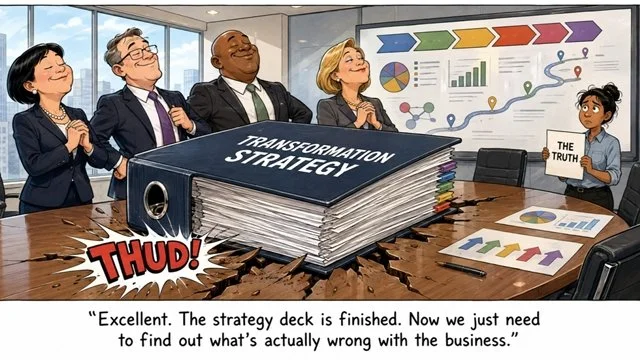
I have, however, seen plenty fail while surrounded by glossy presentations, complicated dashboards, steering committees, endless workstreams and enough corporate gobbledygook to confuse NASA.
Everyone is incredibly busy - Meetings about meetings - Committees forming subcommittees - Spreadsheets multiplying like rabbits.
Progress reports glowing reassuringly green—right up until the transformation quietly misses its objectives, runs out of steam or disappears into the corporate Bermuda Triangle.
Or, as I frequently say:
“NEVER CONFUSE MOTION WITH PROGRESS!”
The first problem is that many leadership teams don’t start with the truth about where the business REALLY is.
They start with where they would like everyone to believe it is.
The board gets one version - The executive team gets another.
The people at the coalface know something completely different.
And the customer, who has been shouting into the abyss for months, has usually given up and moved to a competitor.
Before deciding where the business wants to go, somebody needs to ask:
What is genuinely working? - What is broken? - Where are we losing money? - Why are customers leaving? - Which people and processes are helping the business—and which are quietly strangling it?
And what uncomfortable truths are being diluted, massaged or airbrushed as they travel up towards the Ivory Tower?
Transformation cannot begin with organisational mythology.
It must begin with an honest diagnosis.
Then comes the THUD Strategy.
Those who have read some of my previous ramblings may remember this particular beast: the enormous, chunky-munky strategic dossier that lands on the boardroom table with a mighty THUD!
Inside?
Endless data - Polished graphics - The latest new-age buzzwords - And arrows pointing in every direction except, apparently, forward.
These things can cost a small fortune and may look terribly impressive. The problem is that nobody outside the room where they were created truly understands them—never mind knowing what they are supposed to do differently on Monday morning.
If your strategy requires a translator, it has already failed.
A good strategy should create clarity, not fog.
What are our priorities? - What are we choosing NOT to do? - Who owns each outcome?
What must be delivered? - By when?
And how will we know whether we are genuinely making progress?
If five people collectively “own” something, there is a fair chance nobody owns it.
This is where many transformations hit the execution gap.
The strategy may be sound, but somewhere between the boardroom and the shop floor, clarity evaporates. Leaders then wonder why executing it feels like pushing jelly up a ladder!
Communication is another favourite.
One town hall, a motivational video and a few transformation-branded coffee mugs do not constitute communication.
When leaders fail to communicate clearly and constantly, employees fill in the blanks themselves.
That’s when corridor chatter, WhatsApp groups and the company rumour mill become the organisation’s most trusted news channels.
People don’t necessarily fear change.
They fear BADLY managed change—particularly when it is delivered by leaders pretending to possess certainty they don’t actually have.
Sometimes the most powerful thing a leader can say is:
“We don’t have every answer yet. But here is what we know, here is what we’re doing, and here is when you will hear from us again.”
And then actually follow through.
Finally, the people expected to deliver the transformation are too often treated as an afterthought.
Technology matters - Processes matter - Operating models matter.
But it is people who ultimately determine whether a strategy lives or dies.
That is what I call the PEOPLE SIGMA—the collective energy, trust, experience, capability and commitment inside an organisation.
Ignore it, and even the cleverest strategy will quietly unravel.
This doesn’t mean endless dog-and-pony rah-rah sessions or dishing out liberal measures of corporate lip service.
It means listening - Being honest - Creating some positive agitation - Applying tough love when required.
Giving people absolute clarity about what needs to change, why it matters and what part they play in making it happen.
Transformation should not be measured by how much activity it generates.
It should be measured by whether the business becomes demonstrably better.
So, before commissioning another strategy deck, launching another workstream or booking the next off-site at an exotic location—usually with a spa and golf course attached—perhaps start somewhere less glamorous:
Tell the truth about where the business really is.
Because without truth, you don’t have a transformation strategy.
You have corporate theatre.
For those who have led or lived through a transformation: what is the uncomfortable truth that organisations most often refuse to confront?
Comments welcomed, as always!
MC